
From The Practice For The Practice
Powerful Complementary
Oncological Acupuncture
“Why acupuncture for my cancer? After all it only helps with back pain, or?” Cancer sufferers are initially surprised when I create a complementary oncological therapy plan including acupuncture. Well-known and partly subsidized by statutory health insurance, Western-standardized pain acupuncture for knee or back pain, is often applied (mostly) locally according to the “Davos method”, i.e. where it hurts. Surprise cancer patients with extended therapy options of classical Chinese, systemic acupuncture.
From Empiricism To Science
For decades, Western conventional medicine dismissed acupuncture as unspecific and unproven: local messenger substances would be released in response to a puncture stimulus, as with any external stimulus. The rest was generated by faith – until the basic research of Pomeranz and Cheng in the 1980s surprised with the proof of systemic endorphin release and effect on the autonomic nervous system [1]. Both make physiologically and plausibly comprehensible what had previously only been observed epidemiologically: acupuncture switches from the whip of the sympathetic nervous system with its tension to the parasympathetic nervous system with relaxation, from cold extremities to pleasant blood circulation, from anxiety to serenity, from malfunction to orthofunction – a treasure trove of complementary oncological indications.
Put In A Nutshell
“It doesn’t matter where you prick,” claims one of the first major Western studies GERAC in 2005, conducted with doctors who only had the A-diploma in acupuncture with just 140 hours versus six years of university studies in China [2]. The ART study, initiated by AOK, DAK and TK in 2005 [3], and a US study by Berman [4] with B-diploma level have finally proven a difference when the point was actually hit, when the “De Qi” was triggered – noticeable either as a feeling of pressure, pulling or similar to a short electric tweak. Curiously, the anatomy of the acupuncture point was not identified in China, but rather at a German university. In about 85% of the classic acupuncture points, Professor Heine discovered a morphological correlate as early as 1988 [5]: First, the acupuncture point is situated in the outer body fascia, which was only discovered therapeutically valuable by physiotherapists much later. Second, this opening, the foramen, has a passage point for a vascular nerve bundle. To ensure that movements neither interrupt the blood flow nor trigger neuronal pain, two concentrically arranged collagen cylinders, similar to an inflated flotation belt, buffer [1]. And third, Kellner histologically counts twice as many receptors in the cells of this flotation belt as in the tissue half a centimeter next to it [6]
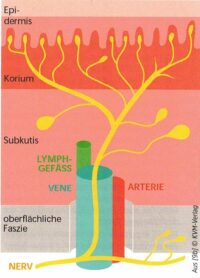 Figure 1: Physiology of the acupuncture point
Point-Specific Effect
Is it relevant for everyday practice which point is acupunctured, or is acupuncture in the area of any foramen with a vascular nerve bundle and twice the receptor density sufficient? Here, too, the instrumental verification is convincing: for example, Litscher et al. can use functional magnetic resonance imaging to demonstrate, increased blood flow in the visual cortex when Li-3, a distant point for the eye, is acupunctured [7]. This leads to the next question: Would it be therapeutically sufficient to know some complementary oncological point combinations?
Mysticism Meets Biocybernetics
Those who are open to the traditional Chinese model of action and/or thought concept will be rewarded with an expanded range of oncological therapies – and, with comprehensibility thanks to modern scientific control loop models.
In the 1990s, for example, the universal theorist, biochemist and biocyberneticist Vester succeeded in translating ancient Chinese mysticism into universal biocybernetics [8]. A flowery 5-element doctrine becomes a biocybernetic sinusoidal curve of recurring activity directions, visualizable in the annual course of an apple tree [9a, b].
- In spring, when the sun shines stronger and warmer again, the waiting energy of a previously outwardly winter-bare tree explodes with fresh greenery and blossoms. Everything is full of zest for action, everything full of “sap and strength”.
- In summer , the apple tree reaches the highest activity it can: apples.
- In autumn , the energy direction changes, the apples are brought in from outside to inside.
- Finally, in winter , not only does the apple tree solidify, but also its fruits are also brought to solidification. They are preserved so that they ensure their own and the apple-eaters’ winter survival.
In order to keep a sine curve swinging up and down repeatedly, a centering point, the zero line, is required.
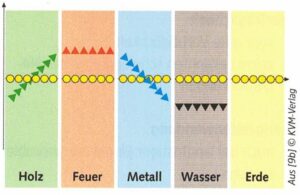 Figure 2: Biocybernetic model of the five activity directions, entire course
The directions of activity, the energy levels of the individual swings of the sinus curve are universally transferable, for example to the stages of a person’s life. Chinese medicine rationally assigns five functional circuits to them – with corresponding functions that make an advantageous holistic use of acupuncture understandable. Start with a few but impressively effective examples for a plus in help for your oncological patients, for a plus in therapeutic success.
Spring: Wood Element
When it comes to the element wood, TCM does not have the image of a gnarled German oak tree in mind, but rather of a bamboo that is flexible with sappiness. If you grab it, bend it down and let it shoot up, it illustrates the direction of activity with its waiting tension. Suitable organ systems and tissues such as muscles, tendons, fascia and the eye with its fine muscle flexing are therefore assigned. Cancer patients often report painful tension due to worries and fears and/or due to reduced agility. Many suffer chemo-related deterioration of vision. Here, acupuncture points such as the distant eye point Li-3* or the European master point of skeletal muscle GB-34* are effective “complementary therapeutics”.
Summer: Fire Element
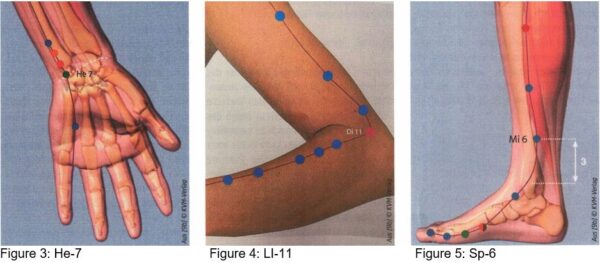
The element of fire symbolizes the highest activity that can be achieved, like the summer midday sun at its highest zenith. Applied to humans, fire corresponds to the highest that Homo sapiens achieves (or should achieve …), personality, mental power, intellect. Appropriately, an organ that enables our brain to be creative in the first place and shines with the highest activity is associated with the tireless pumping heart and with the associated blood vessels. He-7 (Fig. 3) provides psychosomatic support, alleviates emerging panic, calms, helps to achieve inner balance and thus supports, for example, psycho-oncological support. He-7 is also indicated for organ pathologies such as radiatio- or chemotherapy-related heart damage.
Autumn: Metal Element
The metal element is of particular interest to immunodepressed chemotherapy patients. The graphic representation as spades, railway tracks or knight’s shields symbolize the border-crossing or border-protecting symbolism. The associated organ systems or tissues, the lungs, intestines and skin all originate from the same embryonic layer and all represent the boundary layers of our organism between outside and inside [9]. With acupuncture points such as LI-11 (Fig. 4), cancer patients experience an impulse to the immune system. LI-4 not only supports the intestine, e.g. in chemotherapy-related maldigestion, but can also helps ward off freshly caught infections in immunodepression as “The Big Eliminator”.
Winter: Water Element
“Water is life”, or “without water no life” – as a most unequivocal symbol. In TCM, this does not mean the typical waterfall motif of many Feng Shui posters, but rather a deep lake. In winter, the surface solidifies to ice, protects the water inhabitants and the rest of the year the lake supplies vital water. In water, the sinus curve is situated at the lowest point. Here is the basis of all life (hereditary factors), here is the basis of the fire of life (reproduction), the life battery (aging process). The fact that ovaries and testicles are not explicitly assigned, but rather the kidneys, is explained embryologically if the gonads are still located near the kidneys. In addition, the “kidney caps”, the adrenal glands, produce vitality hormones such as cortisol, adrenaline and dopamine, which are essential for survival. The strongest, supportive organs and tissues such as bones and teeth are appropriately assigned. BI-11 can support the bone system as a Chinese master point, for complementary oncology in the case of osseous metastasis. The supply of infrared heat by means of moxibustion to Ki-3 acts on the original energy like a phytotherapeutic roborant, an excellent supporting point for revitalization in chemotherapy-induced fatigue.
Central: Earth Element
In ancient China, the mother symbolized the center of the family. She holds everything together, she puts the food on the table, she provides security. Even in times of gendering**, this biologically understandable symbolism is helpful for understanding a direction of activity that has no direction at all, but rather represents a resting point, the center. The zero point of the sine curve “recalls” the curve, the fire does not burn up to the stratosphere, the water does not solidify into ice. Instead, a recurring cycle is created. With their compensatory, balancing character, earth points like universal St-36 and Sp-6 (Fig. 5) support the entire genital system in the abdomen. Furthermore, this functional circuit is responsible for the metabolism and thus for the provision of nutrients from the supplied food. A digestive system weakened by chemotherapy metabolizes less well. To ensure that valuable phytotherapeutics are better absorbed, St-36 is used. Sp-10 can support complementary-oncological blood formation in immunodeficiency and/or during chemotherapy.
Importance Of Complementary Oncological Acupuncture
There is a good medical reason for the phrase “can support” frequently used in this article: In TCM, acupuncture is only in third place in a holistic therapy concept when it comes to Qi deficiency states such as consuming cancer illnesses. Acupuncture can move the Qi, gives an impulse in the right direction as a stimulus regulation therapy, but cannot supply energy itself. For a successful, effective therapy that is noticeable for cancer sufferers, it is therefore indispensable to consider the first two pillars of the therapy concept: Number two is the supply of for example vitalizing, immunosupportive phytotherapy with medicinal herbs and medicinal mushrooms. Number 1, as in Western naturopathy, is nutrition.
Nutritive Roboration And Vitalization
The 5-element or functional circuit doctrine of TCM includes not only organs, tissues and meridians with corresponding acupuncture points, but also food, empirically assigned for centuries. The traditional Chinese nutritional wisdom requires a more comprehensive factual knowledge than the acupuncture teachings, but especially in the case of serious illnesses, it is worth taking a look at the cooking pot [10]. This also surprises with scientific verification. Here are some (learning) appetizing examples for cancer patients:
- Millet, “maternally nourishing” assigned to the element earth , gives digestible strength for indigestion during chemotherapy and is Western ecotrophologically gluten-free, wholesome, full of valuable vegetable proteins.
- You can try out the element water for yourself: sesame is a convincing plant-based calcium supplier. All of Asia and half of Africa successfully strengthens the bones completely free of cow’s milk with the sesame salt Gomasio, which consists of 90% roasted sesame seeds and 10% salt, both finely powdered together.
- Or how about a delicious strengthening of the elements earth and water, e. metabolism and life battery, with Mediterranean lime salmon on whole meal spelt spaghetti [10]. (Fig. 6 – photo not shown in this edition)
Conclusion
Anyone who takes a look over the Great Wall of China with constructive-critical openness and scientific curiosity will be rewarded – not only with acupuncture – with a plus in terms of help and a plus in effect for cancer patients. And that is exactly what naturopathy and empirical medicine can do: complementary support with experience.
Dr. med. Susanne Bihlmaier
Keywords: Acupuncture, Complementary Oncology, Traditional Chinese Medicine (TCM), 5-Elements-Teaching
CLW Footnotes:
* All point designations are in OICS / AJCM Nomenclature.
** The German word “Gendern” used in this sentence is the practice in the German language of using gender-inclusive language to represent both men and women (and non-binary people) instead of relying solely on the traditional generic masculine form.
 An Exclusive Translated Article for P2P Supporters
Published November 2026
From an article in CO’med, Volume 32, July 2026
Translation & redaction by: Carolyn L. Winsor, P2P Consulting
© Copyright 2026, CO’med, Susanne Bihlmaier, Germany
AI Digital and online translation assistance utilized.
The Author
Dr. med. Susanne Bihlmaier
Dr. med. Susanne Bihlmaier has been specializing in European and Asian naturopathy with a focus on complementary oncology and Chinese medicine for 25 years. She received a science prize for bridging the gap between university medicine and acupuncture. Her textbook “Die Akupunktur” (Acupuncture) published by KVM Verlag is in its 3rd edition, the cookbook and health book “Tomato Red + Dragon Green” is published by Hädecke Verlag in its 8th edition, and “Notfall-Apotheke-Natur” (together with her husband Armin) is in the 2nd edition.
Book Tip:
Susanne Bihlmaier: Die Akupunktur 2020 KVM Verlag, 2020
ISBN 978-3-86867-492-7
Literature
- Pomeranz B. Wissenschaftliche Grundlagen der Akupunktur. In: Stux G, Stiller N, Pomeranz B. Akupunktur – Lehrbuch und Atlas. Berlin: Springer; 1989.
- Studienreihe GERAC [Internet]. [Zugriff am 27 April 2026]. Verfügbar unter: gerac.de
- Stör W Modellvorhaben Akupunktur: überragende Wirksamkeitsnachweise für die Akupunktur! Dtsch Z Akupunkt 2005:48(3):34-36.
- Berman BM, Lao L, Langenberg P, Lee WL, Gilpin AM, Hochberg Effectiveness of acupuncture as adjunctive therapy in osteoarthritis of the knee: a randomized, controlled trial. Ann Intern Med. 2004;141(12):901-910.
- Heine H. Funktionelle Morphologie der Akupunktur. Akupunktur Theorie und Praxis. 1988.
- Kellner G. Bau und Funktion der Haut. Dtsch Z Akupunktur. 1966;1:1-31.
- Litscher G, et Die schmerzfreie Lasemadelakupunktur moduliert die Gehirnaktivität: Erste Nachweise mit fTCD und fMRI. Schmerz und Akupunktur. 2004;1:4-11.
- Vester F Neuland des Denkens. Vom technokratischen zum kybernetischen Zeitalter. München: Deutscher Taschenbuch Verlag; 1980.
9a. Ramakers E. Physiologie der TCM. Vortrag an der Gottfried Gutmann Akademie; 2001 Jan; Hamm.
9b. Bihlmaier S. Die Akupunktur. 3. Aufl. Heidelberg: KVM Verlag; 2020.
10. Bihlmaier S. Tomatenrot + Drachengrün, Das Beste aus Ost und West, antikrebsaktiv. 8. Aufl. Rottenburg: Hädecke Verlag; 2026.